Supply Chain Management: Discover Logistics, Inventory Systems and Business Strategies
Supply chain management is the process of planning and coordinating the movement of raw materials, components, finished products, information and payments from suppliers to customers. It connects procurement, manufacturing, warehousing, transportation, distribution and inventory management into one coordinated business operation.
A well-managed supply chain helps companies maintain product availability, plan production, control inventory levels and respond to changes in customer demand. It also improves coordination between suppliers, manufacturers, distributors, logistics partners and retailers.
In India, supply chain management is particularly important because businesses operate across different regions, transportation networks, industrial centres and customer markets. Companies may need to coordinate road, rail, air and maritime transportation while managing documentation, GST requirements, warehouse operations and delivery schedules.
Modern supply chain management increasingly relies on digital platforms, enterprise resource planning systems, warehouse management software, transportation management tools and real-time tracking technologies.
The objective is not simply to move products from one location to another. It is to create a reliable, transparent and financially sustainable system that supports business growth.
Why Supply Chain Management Matters
Supply chain performance can influence a company's operating expenses, customer experience, production capacity and financial position.
Important business benefits include:
Better inventory control: Companies can maintain appropriate stock levels and reduce unnecessary accumulation of materials.
Improved procurement planning: Structured purchasing processes help businesses coordinate supplier deliveries with production requirements.
Reliable product availability: Better forecasting and replenishment planning can reduce stock shortages.
Efficient transportation: Route planning and shipment consolidation can improve delivery coordination.
Stronger supplier relationships: Performance monitoring helps companies identify reliable suppliers and address recurring issues.
Improved cash flow: Inventory planning can reduce the amount of working capital tied up in excess stock.
Better customer experience: Accurate delivery estimates and consistent product availability support customer satisfaction.
Operational visibility: Digital systems provide information about orders, shipments, warehouse activity and inventory movements.
A strong supply chain also helps businesses respond to unexpected disruptions such as supplier delays, transportation interruptions, demand fluctuations and changes in regulatory requirements.
Main Components of Supply Chain Management
A supply chain includes several interconnected activities. Weakness in one area can affect the performance of the entire operation.
1. Procurement and Supplier Management
Procurement involves identifying business requirements, selecting suppliers, negotiating commercial terms and arranging the purchase of materials, equipment or finished products.
Supplier management continues after the purchase order is issued. Companies must monitor delivery performance, product quality, contractual compliance and financial reliability.
Important procurement activities include:
Identifying and evaluating potential suppliers.
Comparing quotations and commercial terms.
Checking product specifications and quality standards.
Negotiating delivery schedules.
Preparing purchase orders.
Monitoring supplier performance.
Maintaining approved supplier records.
Reviewing supplier concentration and dependency risks.
Businesses should avoid depending entirely on one supplier for critical materials unless the arrangement is supported by suitable contingency planning.
2. Production and Manufacturing Planning
Manufacturing companies need to coordinate material availability, workforce capacity, production schedules and equipment utilisation.
Production planning helps determine what needs to be manufactured, how much is required and when materials should reach the facility.
Common activities include:
Production scheduling.
Material Requirements Planning (MRP).
Capacity planning.
Bill of Materials (BOM) management.
Quality inspection.
Work-in-progress tracking.
Production performance monitoring.
If raw materials arrive late, production schedules may be interrupted. If procurement exceeds actual requirements, excess stock can increase storage and financing pressure.
3. Warehouse Management
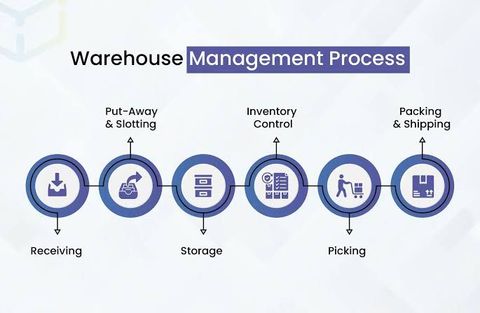
Warehousing involves receiving, storing, organising, protecting and dispatching inventory.
A warehouse management system (WMS) helps coordinate daily warehouse activities and improve stock visibility.
Typical warehouse functions include:
Goods receiving and inspection.
Storage location assignment.
Barcode and RFID scanning.
Inventory counting.
Order picking and packing.
Dispatch management.
Returns processing.
Warehouse performance reporting.
Warehouse layout also matters. Frequently requested products may be placed in accessible locations, while specialised storage areas may be required for temperature-sensitive, hazardous or high-value materials.
4. Inventory Management
Inventory management ensures that a business maintains suitable quantities of raw materials, work-in-progress and finished products.
Too much inventory can tie up working capital and increase storage requirements. Too little inventory can interrupt production or delay customer orders.
Important inventory management methods include:
ABC Analysis: Classifies inventory according to its annual consumption value. High-value items generally receive closer monitoring than lower-value items.
FIFO (First In, First Out): Prioritises the use or dispatch of older inventory before newer inventory. It is useful for products where age or expiry matters.
FEFO (First Expiry, First Out): Prioritises stock with the earliest expiry date. This is especially relevant to pharmaceuticals, food and other perishable goods.
Economic Order Quantity (EOQ): Estimates a suitable order quantity by considering relevant ordering and holding costs.
Safety Stock: Maintains additional inventory to help protect against unexpected demand or supplier delays.
Just-in-Time (JIT): Coordinates material deliveries closely with production requirements to reduce unnecessary inventory. It requires reliable suppliers and careful scheduling.
5. Transportation and Distribution
Transportation management coordinates the movement of products between suppliers, factories, warehouses, distributors and customers.
Common transportation methods include:
Road freight.
Rail freight.
Air cargo.
Coastal shipping.
Inland waterways.
Multimodal transportation.
Businesses should evaluate transportation options according to delivery deadlines, product characteristics, shipment size, distance and handling requirements.
Distribution planning also involves selecting warehouse locations, delivery routes, transport partners and shipment consolidation methods.
6. Returns and Reverse Logistics
Reverse logistics manages the movement of products from customers or distribution points back to the business.
It can involve:
Product returns.
Damaged goods.
Warranty-related replacements.
Packaging recovery.
Product refurbishment.
Recycling and disposal.
Recall management.
A structured returns process helps businesses identify recurring product quality issues and reduce confusion between customer support, warehouse and finance teams.
Important Supply Chain Management Strategies
Businesses can improve supply chain performance by combining operational planning, supplier coordination and technology.
1. Demand Forecasting
Demand forecasting estimates future product requirements using historical sales, seasonal patterns, market information and customer orders.
A company can use forecasting to prepare purchasing plans, production schedules and inventory targets.
Common forecasting inputs include:
Previous sales volumes.
Seasonal demand changes.
Promotional activity.
Customer order history.
Market trends.
Supplier lead times.
Product lifecycle information.
Forecasts should be updated regularly because unexpected market changes can make earlier estimates unreliable.
2. Strategic Supplier Selection
Choosing suppliers only on the basis of the lowest quoted price can create long-term operational risks.
A supplier evaluation process should consider:
Product quality.
Delivery reliability.
Production capacity.
Financial stability.
Geographic location.
Compliance requirements.
Communication quality.
Continuity planning.
For critical materials, companies may consider alternative suppliers, approved substitutes and contingency arrangements.
3. Inventory Optimisation
Inventory optimisation involves balancing product availability with storage requirements and working capital.
Businesses can establish minimum and maximum stock levels for important items. Reorder points can be calculated using expected demand during supplier lead time and an appropriate safety stock allowance.
Regular cycle counts and physical stock verification can also identify discrepancies between warehouse quantities and accounting records.
4. Warehouse and Distribution Network Planning
Warehouse locations influence delivery times, freight arrangements and inventory distribution.
A company should review:
Customer locations.
Supplier locations.
Manufacturing facilities.
Transportation connectivity.
Warehouse capacity.
Labour availability.
Storage conditions.
Regional demand patterns.
Businesses with multiple warehouses may use centralised inventory visibility to coordinate stock transfers and reduce unnecessary duplication.
5. Transportation Cost and Route Planning
Transportation planning should consider the total operational impact of each route rather than just the distance travelled.
Important factors include:
Vehicle capacity.
Delivery deadlines.
Road conditions.
Fuel consumption.
Toll expenses.
Loading and unloading time.
Return journeys.
Shipment consolidation opportunities.
Route optimisation software can help businesses identify more efficient delivery sequences and improve vehicle utilisation.
6. Supply Chain Risk Management
Supply chains can be affected by natural disasters, geopolitical developments, supplier failures, infrastructure interruptions and sudden demand changes.
Companies should identify critical risks and develop response plans.
A practical risk management process includes:
Identify critical materials, suppliers and distribution routes.
Assess the likelihood and potential impact of disruptions.
Identify alternative suppliers and transportation options.
Maintain appropriate safety stock for critical items.
Establish escalation and communication procedures.
Review contingency plans through periodic exercises.
Businesses should pay particular attention to single-source suppliers and materials with long replacement lead times.
Supply Chain Management Systems and Software
Technology helps companies coordinate activities that may otherwise be managed through disconnected spreadsheets and manual communication.
| System | Main purpose | Typical business users |
|---|---|---|
| ERP | Integrates finance, purchasing, inventory and operations | Medium and large enterprises |
| WMS | Manages warehouse receiving, storage and dispatch | Warehousing and distribution teams |
| TMS | Coordinates freight planning and transportation | Logistics and distribution companies |
| MRP | Calculates material and production requirements | Manufacturers |
| SCM platform | Connects different supply chain functions | Enterprise operations |
| Inventory software | Tracks stock levels, movements and replenishment | Retailers and wholesalers |
| Supplier management platform | Organises supplier records and performance | Procurement teams |
Enterprise Resource Planning (ERP)
ERP systems integrate several business functions into a shared platform.
A company can use ERP software to connect purchase orders, inventory records, production activity, invoices and financial reports.
Warehouse Management System (WMS)
A WMS supports warehouse operations through digital stock records, barcode scanning, location management, picking instructions and dispatch reporting.
Transportation Management System (TMS)
A TMS helps businesses plan shipments, select carriers, track deliveries and review freight performance.
Supply Chain Planning Software
Supply chain planning platforms support demand forecasting, inventory planning, production scheduling and replenishment decisions.
Popular Supply Chain and ERP Software Platforms
Several technology providers support different aspects of supply chain management.
SAP: <Entity value="SAP" category="brand" disambig="Enterprise software and ERP technology provider"/> provides enterprise resource planning and supply chain management platforms used for procurement, production, inventory and logistics planning.
Oracle: <Entity value="Oracle" category="brand" disambig="Enterprise software, database and cloud technology provider"/> provides supply chain management applications covering planning, procurement, manufacturing, inventory and order management.
Microsoft Dynamics 365: <Entity value="Microsoft Dynamics 365" category="software" disambig="Enterprise business applications and ERP platform"/> includes business applications that connect finance, operations, inventory and supply chain activities.
Infor: <Entity value="Infor" category="brand" disambig="Enterprise resource planning and industry-specific business software provider"/> provides ERP and supply chain applications for manufacturing, distribution and other industries.
Odoo: <Entity value="Odoo" category="software" disambig="Open-source and commercial business management software platform"/> provides inventory, purchasing, manufacturing and other business management applications.
Zoho Inventory: <Entity value="Zoho Inventory" category="software" disambig="Inventory and order management application"/> supports inventory tracking, order management and warehouse-related workflows for eligible business needs.
The right platform depends on company size, operational complexity, integration requirements, reporting needs and implementation resources. Businesses should compare functionality and total ownership requirements before choosing a system.
Supply Chain Performance Metrics
Key Performance Indicators (KPIs) help management understand whether supply chain operations are meeting business objectives.
| KPI | What it measures | Why it matters |
|---|---|---|
| Inventory Turnover | How frequently inventory is sold or consumed | Indicates inventory movement |
| Order Fulfilment Rate | Percentage of orders completed as required | Measures fulfilment performance |
| On-Time Delivery | Deliveries completed within the promised period | Evaluates logistics reliability |
| Order Cycle Time | Time between order placement and fulfilment | Measures process speed |
| Supplier Lead Time | Time taken by suppliers to fulfil orders | Supports procurement planning |
| Stockout Rate | Frequency of unavailable products | Highlights inventory gaps |
| Forecast Accuracy | Difference between forecast and actual demand | Evaluates planning quality |
| Warehouse Utilisation | Use of available storage capacity | Supports space planning |
Companies should select a manageable set of KPIs that reflect their actual business objectives. A manufacturer may focus on production continuity and material availability, while an ecommerce retailer may prioritise fulfilment speed, inventory accuracy and return rates.
Supply Chain Management in Different Industries
Supply chain requirements vary depending on product characteristics and customer expectations.
Manufacturing
Manufacturers coordinate raw materials, components, production schedules, quality checks and finished goods distribution.
Retail and Ecommerce
Retail businesses focus on product availability, demand forecasting, warehouse operations, order fulfilment and returns.
Pharmaceuticals
Pharmaceutical supply chains require careful inventory tracking, appropriate storage conditions, batch records and expiry management. Temperature-sensitive products may require specialised cold-chain monitoring.
Food and Agriculture
Food supply chains need careful handling, freshness management, traceability and temperature control where applicable.
Automotive
Automotive manufacturers coordinate large supplier networks, specialised components, production schedules and quality standards.
Construction
Construction companies manage materials, equipment, project schedules, supplier deliveries and storage at multiple project locations.
Recent Developments in India's Supply Chain and Logistics Sector
1. National Logistics Policy Progress
India's National Logistics Policy, launched on 17 September 2022, focuses on creating an integrated, technology-enabled and efficient logistics ecosystem.
The policy complements PM GatiShakti and covers digital integration, infrastructure coordination, process improvements, workforce development and logistics performance.
In September 2025, the Ministry of Commerce and Industry reported that the Unified Logistics Interface Platform (ULIP) had facilitated more than 160 crore digital transactions through integrations across logistics-related systems. It also reported that the Logistics Data Bank had tracked more than 75 million export-import containers across 101 Inland Container Depots. <Cite refs={["turn478509search0","turn478509search4"]} />
2. Logistics Cost Assessment
A government announcement published on 27 November 2025 reported an estimated Indian logistics cost of 7.97% of GDP, based on an assessment involving DPIIT and NCAER.
The estimate reflects the government's logistics measurement work and should be understood in the context of its methodology rather than treated as a universal figure for every company or shipment. <Cite refs={["turn478509search2","turn478509search33"]} />
3. PM GatiShakti and Integrated Infrastructure Planning
PM GatiShakti supports coordinated infrastructure planning through geospatial information and cross-ministry data integration.
For businesses, improved connectivity planning can influence decisions about factories, warehouses, industrial locations and transportation networks. The National Logistics Policy complements this approach by focusing on logistics processes and digital integration. <Cite refs={["turn478509search6","turn478509search10"]} />
4. Digital Logistics and Data Integration
Platforms such as ULIP support information exchange between logistics-related systems through digital integrations.
Better visibility into shipment movements and related records can help businesses coordinate transportation, identify delays and improve logistics planning. Companies should still validate the quality and timeliness of information received from individual data sources.
Laws and Regulatory Requirements in India
Supply chain operations may involve several legal and regulatory frameworks. The requirements depend on the products handled, business activities, transportation methods and locations.
Goods and Services Tax (GST): GST requirements affect invoicing, input tax credit, movement of goods and maintenance of business records.
E-Way Bill Rules: Under the applicable GST rules, an e-way bill is generally required before the movement of goods where the consignment value exceeds ₹50,000, subject to prescribed exceptions and conditions. Businesses should check applicable state-specific and category-specific requirements.
Companies Act, 2013: Companies must maintain appropriate accounting records and comply with relevant financial reporting and corporate governance responsibilities.
Food Safety and Standards Act, 2006: Businesses handling food products may need to comply with FSSAI licensing, food safety, storage and traceability requirements.
Legal Metrology Act, 2009: Applicable packaged goods may be subject to declarations and measurement-related requirements.
Motor Vehicles Act, 1988: Road transportation activities are subject to relevant vehicle, permit, safety and operational requirements.
Carriage by Road Act, 2007: Relevant provisions govern specified aspects of carriage of goods by road and responsibilities of common carriers.
Customs Act, 1962: Import and export supply chains must follow applicable customs declarations, clearance and documentation requirements.
Businesses should identify the laws that apply to their products and operations rather than assuming that every regulation applies equally to all supply chains.
Common Supply Chain Management Challenges
Even well-established businesses can experience operational difficulties.
Supplier delays: Late deliveries can interrupt production and affect customer commitments.
Excess inventory: Overstocking increases storage requirements and ties up working capital.
Demand fluctuations: Sudden changes in customer demand can make forecasts inaccurate.
Transportation disruptions: Weather, congestion, infrastructure problems and route restrictions can affect delivery schedules.
Poor data visibility: Disconnected software and manual records can create inaccurate stock information.
Warehouse inefficiency: Poor storage layouts and picking procedures can increase handling time.
Regulatory complexity: Businesses operating across multiple states or countries may need to coordinate different documentation and compliance requirements.
Technology integration problems: ERP, WMS and TMS platforms may not exchange information correctly without suitable integration and data standards.
A regular review of suppliers, inventory records, logistics performance and technology systems can help businesses identify weaknesses early.
Practical Supply Chain Management Checklist
Companies can use this checklist to review their supply chain operations:
Identify critical suppliers and materials.
Maintain an updated supplier database.
Review supplier delivery and quality performance.
Prepare demand forecasts using current business data.
Establish inventory minimums and reorder levels.
Monitor slow-moving and obsolete stock.
Maintain accurate warehouse records.
Review transportation routes and delivery performance.
Track purchase orders and shipment status.
Reconcile physical stock with accounting records.
Maintain GST and e-way bill documentation where applicable.
Develop alternative sourcing and contingency plans.
Review supply chain KPIs regularly.
Evaluate ERP, WMS and TMS integration requirements.
Train employees in inventory, warehouse and logistics procedures.
Tools and Resources for Supply Chain Management
Businesses can use technology and official government platforms to improve planning and operational visibility.
Unified Logistics Interface Platform (ULIP): Supports digital integration across participating logistics-related systems and provides access to relevant logistics data through approved integrations.
PM GatiShakti: Supports coordinated infrastructure planning and geospatial information for logistics and connectivity decisions.
GST Portal: Supports GST compliance, registration, returns and related documentation.
E-Way Bill Portal: Provides facilities for generating and managing electronic waybills under applicable GST requirements.
ERP Platforms: Connect finance, purchasing, inventory, production and reporting.
Warehouse Management Systems: Help manage goods receiving, storage, picking, packing and dispatch.
Transportation Management Systems: Support freight planning, shipment tracking, route coordination and logistics reporting.
Barcode and RFID Tools: Help identify products, record stock movements and improve inventory accuracy.
Businesses should evaluate software according to their operational requirements, data security needs, integration capabilities and employee training requirements.
Frequently Asked Questions
1. What is supply chain management?
Supply chain management is the coordination of procurement, production, inventory, warehousing, transportation and distribution activities. It helps businesses move materials and products efficiently from suppliers to customers.
2. What are the main components of supply chain management?
The main components include procurement, supplier management, production planning, inventory control, warehousing, transportation, distribution and reverse logistics.
3. What is the difference between supply chain management and logistics management?
Logistics management primarily focuses on the movement, storage and distribution of goods. Supply chain management has a broader scope and includes procurement, supplier coordination, production, inventory planning and logistics activities.
4. Which software is commonly used for supply chain management?
Businesses use ERP, warehouse management, transportation management, inventory management and supply chain planning platforms. Examples include SAP, Oracle, Microsoft Dynamics 365, Infor, Odoo and Zoho Inventory.
5. How can a business improve supply chain efficiency?
A business can improve efficiency through accurate demand forecasting, reliable supplier relationships, inventory optimisation, warehouse planning, transportation coordination, digital tracking and regular performance reviews.
Conclusion
Supply chain management is essential for businesses that depend on reliable procurement, production, inventory and product distribution. By connecting suppliers, warehouses, transportation partners and customers, companies can improve operational coordination and maintain better control over their resources.
Effective supply chain strategies combine accurate forecasting, disciplined inventory management, supplier evaluation, logistics planning and suitable technology. Businesses should also maintain appropriate records and comply with GST, transportation, product-specific and other applicable regulations.
As India's logistics infrastructure and digital platforms continue to develop, companies that invest in reliable supply chain processes and better information visibility can strengthen operational resilience and support sustainable business growth.