Enterprise Data Management: Explore Data Quality, Governance and Business Insights
Enterprise Data Management (EDM) is the structured approach organisations use to collect, organise, store, maintain, protect and analyse information across their operations. It covers data from departments such as finance, sales, marketing, human resources, procurement, manufacturing, customer management and technology.
As businesses adopt cloud platforms, enterprise resource planning systems, customer relationship management software and analytics tools, information often becomes distributed across multiple applications. One department may maintain customer records in a CRM platform, another may hold billing information in accounting software, while operations teams manage inventory through a separate system.
Without common standards, these records can become inconsistent. A customer may appear under different names, product information may not match across systems, and management reports may show conflicting figures.
Enterprise data management addresses these challenges through a coordinated framework for data quality, governance, architecture, integration, security and reporting.
The objective is not simply to store more information. It is to make business data dependable, accessible to authorised users and useful for operational and strategic decisions.
Why Enterprise Data Management Matters
Reliable information influences nearly every important business activity. Financial planning, customer analysis, inventory forecasting, regulatory reporting and risk assessment all depend on the quality of underlying records.
A structured EDM programme can help organisations:
Improve decision-making: Give managers consistent information for evaluating performance and planning business activities.
Reduce data duplication: Identify repeated customer, supplier, product and transaction records across departments.
Strengthen reporting accuracy: Establish common definitions for financial and operational measurements.
Improve operational efficiency: Reduce manual reconciliation and repeated data correction.
Support regulatory compliance: Maintain records, access controls and data handling practices aligned with applicable requirements.
Improve customer understanding: Connect relevant information across interactions, transactions and business channels.
Support analytics and AI: Provide better-quality datasets for forecasting, machine learning and business intelligence.
Manage information risk: Establish controls for sensitive, confidential and business-critical information.
For example, a retail company may discover that its sales, inventory and finance teams use different product identifiers. A coordinated data management framework can standardise product records and help the organisation produce more consistent sales and stock reports.
Core Components of Enterprise Data Management
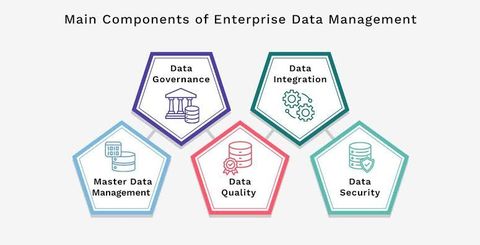
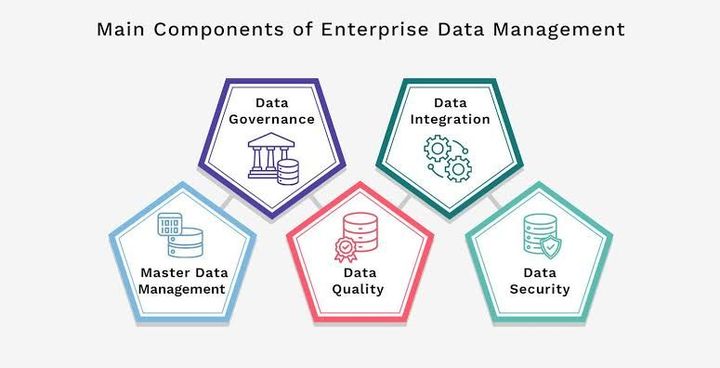
EDM includes several connected activities. Organisations should understand how each component contributes to the overall information lifecycle.
| Component | Main purpose | Business application |
|---|---|---|
| Data quality management | Maintain accurate and consistent records | Reliable reporting |
| Data governance | Define accountability and usage rules | Controlled information management |
| Data architecture | Organise how information is stored and connected | Consistent system design |
| Data integration | Connect information from different platforms | Unified reporting |
| Master data management | Maintain authoritative business records | Consistent customer and product information |
| Metadata management | Document data definitions and context | Easier discovery and interpretation |
| Data security | Protect information against unauthorised access | Reduced information risk |
| Data lifecycle management | Control retention, archival and disposal | Better information oversight |
| Business intelligence | Convert information into useful analysis | Performance monitoring |
These components should operate under shared organisational policies rather than as disconnected technology projects.
Understanding Enterprise Data Quality
Data quality describes how well information meets the requirements of its intended use. A record can be technically valid but still unsuitable for a particular business decision.
For instance, an address may follow the correct format but refer to an outdated customer location. Similarly, a financial record may contain a valid number but be assigned to the wrong reporting period.
Important dimensions of data quality
1. Accuracy
Information should correctly represent the real-world person, transaction, product or event it describes.
For example, a supplier's registered business name and tax identification details should match verified records.
2. Completeness
Required fields should contain the information needed for a specific process. Missing invoice dates, customer identifiers or product classifications can create reporting and reconciliation problems.
3. Consistency
The same information should follow common definitions and standards across connected systems. A company should not use different customer classifications in finance and sales reports without a clear reason.
4. Timeliness
Information should be available within the period required for its intended use. A stock report generated several days after a major transaction may not reflect current inventory conditions.
5. Validity
Records should follow established formats, ranges, business rules and accepted values. For example, a transaction date should follow the organisation's approved date format.
6. Uniqueness
A single real-world entity should not appear as multiple unnecessary records. Duplicate customer or supplier profiles can distort financial and operational reports.
How Businesses Measure Data Quality
Organisations can establish measurable indicators to monitor the condition of their information.
| Data quality metric | What it measures | Example |
|---|---|---|
| Accuracy rate | Records matching verified information | 98% accurate customer records |
| Completeness rate | Required fields containing valid values | 95% complete invoice records |
| Duplicate rate | Records repeated unnecessarily | 2% duplicate supplier profiles |
| Validity rate | Records passing defined validation rules | 97% valid product codes |
| Consistency rate | Records matching common standards | 96% consistent customer classifications |
| Timeliness rate | Information available within the required period | 92% of daily records updated on time |
These figures are illustrative, not industry benchmarks. Each organisation should set targets according to its information risks, business requirements and reporting obligations.
Practical data quality improvement methods
Establish standard formats for dates, addresses, identifiers and financial records.
Validate information when it enters business systems.
Identify and merge duplicate records using approved procedures.
Assign responsibility for correcting important data fields.
Monitor recurring errors and investigate their underlying causes.
Review data quality regularly rather than relying only on one-time cleanup exercises.
Data quality should be managed continuously. Correcting a dataset once will not prevent the same errors from returning if the original capture process remains weak.
Enterprise Data Governance Framework
Data governance defines the policies, responsibilities, standards and decision-making processes that control how information is managed throughout an organisation.
It answers important questions: Who owns a dataset? Who can approve changes? Which departments may access it? How long should records be retained? Who is responsible when information is incorrect or exposed?
A practical governance framework should include the following elements.
Data ownership
A data owner is accountable for a particular dataset or business information domain. For example, the finance department may be responsible for defining financial reporting information, while the HR department oversees employee records.
Data stewardship
Data stewards coordinate everyday data quality activities. They help maintain definitions, review errors, monitor standards and work with technical teams to resolve information problems.
Data custodianship
Data custodians generally manage the technical environment in which information is stored and processed. Their responsibilities may include database administration, backups, access controls and system availability.
Governance committee
A cross-functional committee can establish policies, approve standards, review major data risks and resolve disagreements between departments.
Data policies and standards
Policies should define acceptable data usage, classification, access permissions, quality requirements, retention periods, sharing arrangements and escalation procedures.
| Governance role | Primary responsibility |
|---|---|
| Executive leadership | Approve the overall data strategy |
| Data governance committee | Establish standards and monitor implementation |
| Data owner | Account for a defined information domain |
| Data steward | Coordinate quality and policy compliance |
| Data custodian | Maintain technical controls and storage |
| Information security team | Monitor security risks and access protection |
| Compliance team | Review applicable legal and regulatory obligations |
Clear accountability prevents important information decisions from being left entirely to technology teams.
Master Data Management and Metadata Management
Two important disciplines within EDM are Master Data Management (MDM) and Metadata Management.
What is Master Data Management?
Master Data Management creates and maintains authoritative records for important business entities. These commonly include:
Customers
Suppliers
Products
Employees
Business locations
Legal entities
Financial accounts
For example, a company operating across several regions may maintain multiple customer profiles for the same organisation. An MDM framework can identify matching records, resolve duplication and establish a consistent customer identity across approved systems.
MDM commonly involves matching, validation, record consolidation, approval workflows and synchronisation with connected applications.
What is Metadata Management?
Metadata is information that describes other information. It explains what a dataset contains, where it originated, who owns it, how it is structured and what rules apply to it.
Examples include:
Dataset name and description
Field definitions
Data owner and steward
Source system
Last updated date
Classification level
Permitted usage
Retention requirements
A data catalogue can make metadata easier to search and understand. It helps employees discover relevant datasets without relying entirely on informal communication between departments.
Data lineage is closely related. It tracks where information originated, how it was transformed and which reports, applications or decisions depend on it.
For example, a revenue figure in a management dashboard may originate from sales transactions, pass through an accounting system and then be transformed in a reporting platform. Lineage helps analysts trace the figure back to its source when discrepancies occur.
Enterprise Data Architecture and Integration
Data architecture describes how information is collected, stored, organised, processed and accessed across business systems.
A suitable architecture should support current operational requirements while allowing the organisation to expand its analytics and technology capabilities.
Common enterprise data architecture components
1. Operational databases
These databases support everyday transactions, such as customer orders, payments, inventory movements and employee records.
2. Data warehouses
A data warehouse stores structured information from multiple sources for reporting, historical analysis and business intelligence.
3. Data lakes
A data lake can store large volumes of structured, semi-structured and unstructured information. It may support advanced analytics, machine learning and exploratory data work.
4. Lakehouse architecture
A lakehouse combines aspects of data lakes and data warehouses, aiming to support flexible data storage alongside structured management and analytical capabilities.
5. Integration platforms
These connect applications and datasets through approved interfaces, data pipelines, connectors and transformation processes.
6. Data catalogues
Catalogues help users discover datasets, understand definitions, identify owners and review applicable access conditions.
| Architecture approach | Main strength | Important consideration |
|---|---|---|
| Data warehouse | Structured reporting and analytics | Requires well-defined data models |
| Data lake | Flexible storage for varied information | Needs strong organisation and governance |
| Lakehouse | Supports multiple analytical workloads | Architecture and governance can be complex |
| Data mesh | Domain-oriented data ownership | Requires organisational coordination |
| Hybrid architecture | Combines cloud and on-premises systems | Integration and oversight require planning |
The right architecture depends on business size, existing systems, data volume, security requirements, analytical workloads and technical capabilities.
Turning Enterprise Data into Business Insights
Business insights are conclusions drawn from analysing information. They help organisations understand performance, identify trends, investigate problems and evaluate future possibilities.
Data becomes more useful when it is connected to a clear business question.
1. Financial analysis
Finance teams can analyse revenue, receivables, expenses, cash flow and budget performance. Consistent financial definitions help management compare results across business units.
2. Customer analysis
Customer information can help identify purchasing patterns, repeat interactions, customer segments and changes in demand.
3. Sales performance
Sales teams can monitor conversion rates, regional performance, product demand and pipeline activity.
4. Inventory and supply chain analysis
Businesses can examine stock movement, supplier delivery patterns, inventory turnover and procurement requirements.
5. Workforce analysis
Authorised HR teams can study workforce distribution, training requirements, attendance trends and organisational planning needs while respecting employee privacy.
6. Risk and compliance reporting
Organisations can monitor exceptions, unusual transactions, access activity and reporting obligations using appropriately controlled information.
Common business intelligence tools
Microsoft Power BI
Tableau
Qlik Sense
Looker
Microsoft Fabric
SAP Analytics Cloud
Oracle Analytics
Tool selection should consider data connectivity, security, reporting requirements, scalability, licensing arrangements and employee capabilities.
Practical Steps to Implement Enterprise Data Management
An effective EDM programme should begin with business priorities rather than an immediate investment in multiple platforms.
Step 1: Identify important business information
List the major datasets used across finance, operations, sales, procurement, HR and technology. Identify which information is most important for critical decisions and regulatory reporting.
Step 2: Assess current data quality
Review missing fields, duplicate records, inconsistent formats, outdated information and conflicting business definitions. Prioritise datasets that create the greatest operational or financial risk.
Step 3: Define governance responsibilities
Assign data owners, stewards and custodians. Establish a committee or clearly designated leadership group to approve standards and resolve cross-department issues.
Step 4: Create common data definitions
Develop a business glossary covering important terms, metrics, classifications and reporting rules. This helps different departments interpret information consistently.
Step 5: Establish security and access controls
Classify information according to sensitivity and business importance. Apply role-based access, authentication, encryption and monitoring where appropriate.
Step 6: Improve data architecture
Review databases, reporting platforms, integration pipelines and existing applications. Identify unnecessary duplication and gaps in information flow.
Step 7: Introduce data quality monitoring
Define measurable quality rules and establish regular reporting. Assign responsibility for investigating and correcting recurring problems.
Step 8: Build useful business reports
Develop dashboards and analytical reports around defined business questions. Ensure that reported figures can be traced to approved sources and consistent definitions.
Step 9: Review and improve continuously
Monitor data quality, access activity, reporting accuracy, user feedback and regulatory changes. Update policies when business operations or technology environments change.
Measuring Enterprise Data Management Performance
Organisations should measure both information quality and business outcomes. A programme may improve database accuracy but still fail to deliver value if employees cannot access or interpret the information they need.
Useful performance indicators include:
| KPI | Purpose |
|---|---|
| Critical data quality score | Tracks the condition of important datasets |
| Duplicate record percentage | Measures unnecessary repeated information |
| Data issue resolution time | Evaluates how quickly errors are corrected |
| Data catalogue coverage | Measures how much important information is documented |
| Data lineage coverage | Tracks traceability across systems and reports |
| Unauthorised access incidents | Monitors information security events |
| Report reconciliation rate | Measures agreement between key business reports |
| Data availability | Evaluates whether information is accessible when required |
| Governance policy compliance | Tracks adherence to approved standards |
Management should connect these indicators to business results such as fewer reporting discrepancies, faster analysis, improved forecasting and reduced manual reconciliation.
Risks and Challenges in Enterprise Data Management
EDM can become difficult when organisations have large technology environments, unclear responsibilities or inconsistent business processes.
Fragmented systems: Multiple applications may maintain separate versions of the same information. Integration and common definitions are needed to reduce conflicting records.
Poor data quality: Incorrect or incomplete records can affect financial reports, customer analysis and operational decisions.
Unclear ownership: When no department is accountable for a dataset, errors may remain unresolved and policies may be applied inconsistently.
Security and privacy risks: Excessive access, weak authentication, poor encryption or inappropriate data sharing can expose sensitive information.
Legacy technology: Older systems may not support modern integration methods or common data standards.
Third-party exposure: External platforms and technology partners may process or store important business information. Organisations should assess contractual, operational and security risks.
High implementation complexity: Large-scale programmes may involve data migration, system integration, staff training and changes to established processes.
Poor employee adoption: Employees may continue using spreadsheets or separate records if new systems are difficult to understand or do not meet operational requirements.
A phased approach, supported by clear accountability and measurable priorities, can help reduce these challenges.
Recent Developments in India: 2026
Several developments during 2026 are relevant to enterprise data governance, information sharing and regulatory oversight.
RBI draft guidance on regulatory expectations for data governance
On 15 July 2026, the Reserve Bank of India released draft guidance on data governance for public consultation. The proposed framework covers regulated entities including banks, non-banking financial companies, payment banks and credit information companies.
The draft discusses board oversight, data governance committees, data ownership, stewardship, data architecture, metadata, lineage, data quality, classification and third-party data arrangements. It also emphasises managing information throughout its lifecycle.
This is a draft framework, not a final direction. Financial institutions should monitor subsequent RBI announcements and assess the requirements applicable to their category of regulated entity. <Link ref="turn424579search1" title="RBI announcement on draft data governance guidance"/>.
National Data Governance Framework
In May 2026, the Government of India advanced a National Data Governance framework for improving interoperability and structured data sharing across government institutions.
The framework is based on four broad pillars: data-sharing policies, standardisation, data exchange platforms and governance architecture. It also refers to mechanisms such as API Setu, AI Kosh, DigiLocker and other digital infrastructure.
Although the framework is focused on government data sharing, its emphasis on common standards, metadata, controlled access and interoperability is relevant to wider enterprise data management practices. <Link ref="turn424579search5" title="National Data Governance framework"/>.
Digital Personal Data Protection Rules, 2025
India's Digital Personal Data Protection Rules were notified in November 2025. During 2026, organisations handling digital personal data should prepare for the phased commencement of the Act and Rules, including requirements concerning data processing, security safeguards, individual rights and accountability.
The phased commencement dates are important: certain provisions began on publication, while other provisions are scheduled to commence one year or eighteen months after publication in November 2025. <Link ref="turn424579search34" title="Official DPDP Rules, 2025 Gazette"/>.
Laws and Regulatory Framework in India
Enterprise data management involves several legal and regulatory considerations. The applicable requirements depend on the type of information, the organisation's activities and the industry in which it operates.
1. Digital Personal Data Protection Act, 2023
The DPDP Act establishes India's framework for processing digital personal data. It addresses the obligations of Data Fiduciaries and the rights of Data Principals.
Its principles include lawful processing, consent and transparency, purpose limitation, data minimisation, accuracy, storage limitation, security safeguards and accountability.
Organisations should identify personal data within their systems, document processing purposes, review access arrangements and prepare appropriate procedures for applicable individual rights and data-related incidents.
2. Digital Personal Data Protection Rules, 2025
The Rules provide operational details for implementing the DPDP framework. They were notified on 14 November 2025, with different provisions commencing at different times.
The Gazette specifies that Rules 1, 2 and 17–21 commenced upon publication; Rule 4 is scheduled to commence one year after publication; and Rules 3, 5–16, 22 and 23 are scheduled to commence eighteen months after publication.
As of November 2026, organisations should check the exact commencement status of each provision rather than assume that every requirement applies on the same date. <Link ref="turn424579search34" title="DPDP Rules commencement provisions"/>.
3. Information Technology Act, 2000
The IT Act provides an important legal framework for electronic records and specified cyber-related matters. Businesses should consider its applicable provisions alongside relevant rules, directions and sector-specific obligations.
4. CERT-In Directions, 2022
The Indian Computer Emergency Response Team issued directions in April 2022 addressing specified cybersecurity practices and incident reporting. Applicable entities should review requirements relating to cyber incident reporting, log retention and designated points of contact.
5. Sector-specific regulatory requirements
Financial institutions, insurance companies, healthcare organisations and listed entities may have additional requirements governing recordkeeping, confidentiality, information security, reporting and data access.
For example, RBI-regulated entities should monitor applicable RBI instructions and any final directions that follow its 2026 draft data governance guidance.
Organisations should obtain legal and compliance advice to determine which requirements apply to their particular information and operations.
Tools and Resources for Enterprise Data Management
The technology used for EDM should support the organisation's governance model, architecture and business priorities.
Data quality platforms: Help identify incomplete records, duplicate entries, inconsistent values and validation issues.
Master data management platforms: Support consistent customer, supplier, product and organisational records.
Data catalogues: Document datasets, ownership, definitions, classification and usage information.
Data integration platforms: Connect applications and move information through controlled pipelines.
Data warehouses and lakehouses: Provide environments for centralised analytics and reporting.
Business intelligence platforms: Convert approved datasets into dashboards, reports and performance analysis.
Data security platforms: Support access controls, encryption, monitoring, classification and data protection.
Metadata and lineage tools: Help users understand where information originates and how it changes across systems.
Before selecting a platform, businesses should assess integration compatibility, data residency requirements, security capabilities, scalability, governance features and long-term operating requirements.
Frequently Asked Questions
1. What is enterprise data management?
Enterprise data management is the coordinated process of collecting, organising, governing, protecting, maintaining and analysing information across an organisation. It aims to improve data quality, consistency, accessibility and business usefulness.
2. What is the difference between data management and data governance?
Data management covers the practical activities involved in storing, integrating, maintaining and protecting information. Data governance defines the policies, responsibilities, standards and decision-making structures that guide those activities.
3. Why is data quality important for businesses?
Data quality affects reporting accuracy, financial analysis, customer understanding, forecasting and operational decisions. Incomplete, duplicated or incorrect records can create misleading reports and unnecessary manual work.
4. What is Master Data Management?
Master Data Management is the discipline of creating and maintaining authoritative records for important business entities such as customers, suppliers, products and employees. It helps reduce duplication and maintain consistent information across systems.
5. How can a business begin implementing enterprise data management?
A business can begin by identifying its most important datasets, assessing their quality, assigning ownership, establishing common definitions and introducing suitable security and reporting controls. A phased programme can then expand across additional departments and systems.
Conclusion
Enterprise Data Management helps organisations turn scattered information into a reliable business resource. Data quality ensures that records are accurate and consistent, governance establishes accountability and control, while data architecture and integration connect information across business systems.
When these disciplines work together, companies can improve reporting, strengthen risk management, support regulatory readiness and generate more useful business insights. India's evolving data protection and governance environment makes structured information management increasingly important for organisations handling personal, financial and operational records.
A practical EDM strategy should begin with business-critical information, clear ownership and measurable quality standards. Technology can support the programme, but long-term results depend on consistent policies, employee participation and continuous oversight.